
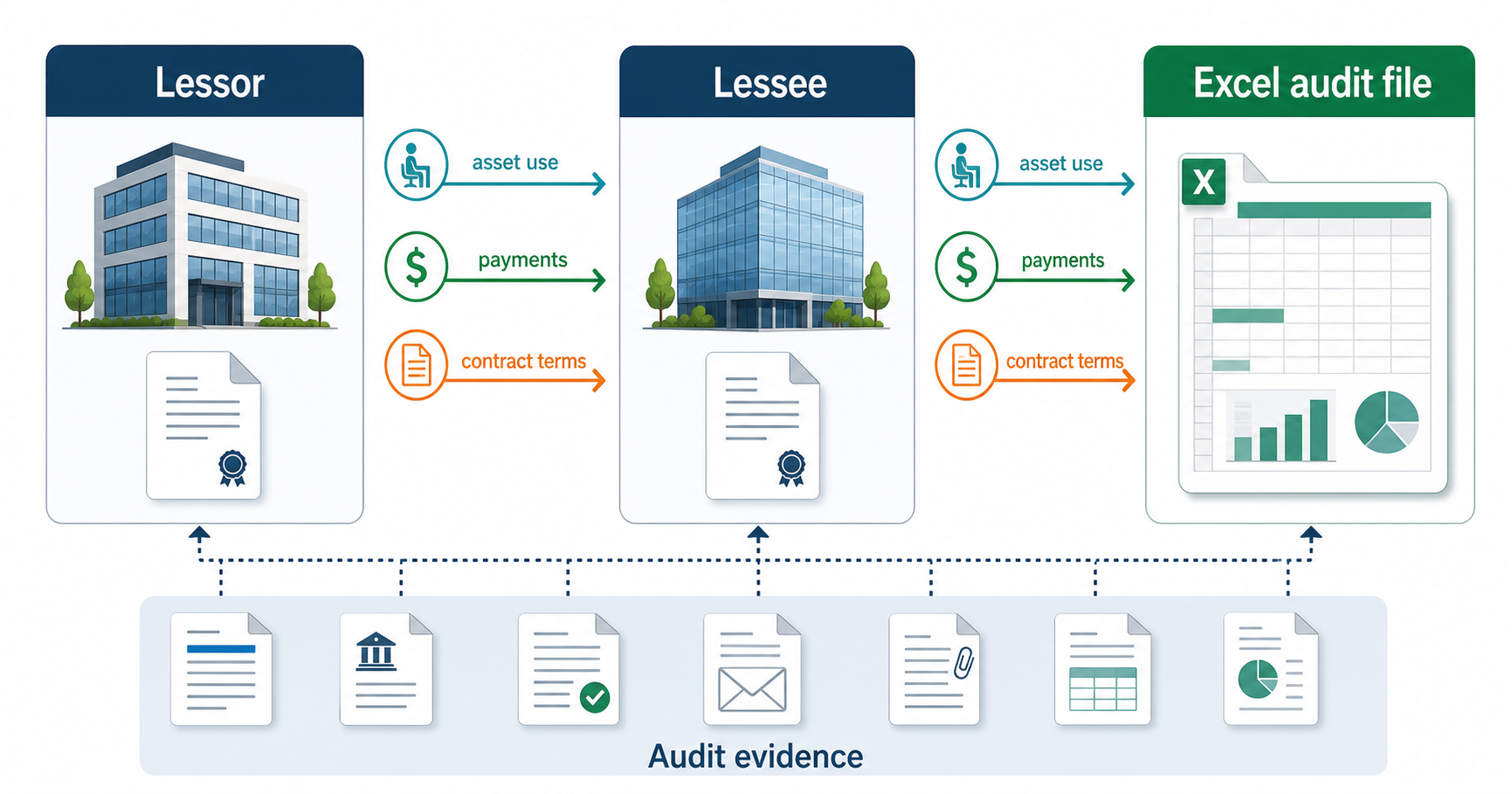
A lessee is the party that gets the right to use an asset under a lease. The lessee usually pays the lessor, follows the contract terms, and uses the asset for a set period.
That definition is simple. The audit work behind it is not.
If your team reviews lease contracts, payment schedules, right-of-use assets, or lease liabilities in Excel, the word "lessee" tells you which side of the agreement you are testing. It tells you who uses the asset, who owes payments, and whose financial statements may need lease accounting entries.
Reviewing lease contracts in Excel? Blast Audit helps auditors extract lease terms from PDFs, link each value back to source evidence, and match payment schedules inside the workbook. Start with Snip for source-linked evidence or Matching for document-to-cell reconciliation.
What Does Lessee Mean?
A lessee is the person or business that receives the right to use property, equipment, vehicles, software, office space, or another asset under a lease agreement.
The other party is the lessor. The lessor owns or provides the asset and grants temporary use to the lessee. Cornell's Legal Information Institute defines a lessor as the property owner who contracts with a lessee to allow temporary possession through a lease: Cornell LII lessor definition.
In plain English:
| Term | Plain meaning | Common example | Audit focus |
|---|---|---|---|
| Lessee | The party using the leased asset | A company renting office space | Lease liability, payment schedule, ROU asset, lease term |
| Lessor | The party providing the asset | A landlord or equipment owner | Rental income, receivable, ownership, classification |
| Lease | The agreement giving use rights for payment | Five-year office lease | Contract terms, commencement date, renewal options |
A tenant in an office lease is a lessee. A company leasing delivery trucks is a lessee. A manufacturer leasing equipment instead of buying it is also a lessee.
For more on both sides of the agreement, read the lessor and lessee comparison.
Why Lessee Meaning Matters in Accounting
For everyday language, "lessee" often means tenant or renter. In accounting and audit, it can change the balance sheet.
Under FASB's lease guidance, organizations that lease assets as lessees are required to recognize assets and liabilities related to the rights and obligations created by leases with terms over 12 months. FASB explains this on its lease project page for Topic 842: FASB leases guidance.
IFRS 16 follows the same broad direction for lessees. IAS Plus summarizes IFRS 16 as using a single lessee accounting model that requires lessees to recognize a right-of-use asset and lease liability: IAS Plus IFRS 16 overview.
That is why the definition matters. If the company is the lessee, auditors usually need to test whether lease obligations are complete, accurately measured, and supported by source documents.
A lessee audit often touches:
- The signed lease contract.
- The lease commencement date.
- The non-cancellable lease term.
- Renewal and termination options.
- Fixed and variable payment terms.
- Lease incentives.
- Purchase options.
- Discount rate support.
- The right-of-use asset.
- The lease liability.
- Reconciliations between lease schedules, general ledger data, and source documents.
For a deeper accounting explanation, see the right-of-use asset guide.
The Audit Risk Behind the Definition
The main audit risk is completeness. If a business is a lessee but misses a lease, liabilities may be understated.
Another common risk is accuracy. A lease may be recorded, but the wrong term, payment schedule, escalation clause, or renewal assumption can distort the calculation.
The third risk is reviewability. Even when the math is correct, the audit file may be weak if the reviewer cannot trace each Excel value back to the lease contract.
That is where the search intent behind "lessee meaning" becomes more valuable than a dictionary answer. A staff auditor may start by asking, "What does lessee mean?" But the real workflow is, "Which side of the lease am I testing, and what evidence do I need in the workbook?"
Real Examples of a Lessee
Example 1: Office Lease
A software company signs a five-year lease for office space. The landlord owns the building. The software company has the right to use the office and pays rent each month.
The software company is the lessee.
An auditor reviewing this lease may test:
- Whether the signed contract is included in the lease population.
- Whether the commencement date agrees to the lease schedule.
- Whether rent escalations were captured.
- Whether renewal options were evaluated.
- Whether payments in the general ledger match the lease schedule.
- Whether the right-of-use asset and lease liability are supported.
This is a typical Excel workpaper task. The contract may be a PDF, the lease schedule may be a spreadsheet, and the rent payments may come from the general ledger. The audit value comes from linking those pieces together.
Example 2: Equipment Lease
A manufacturer leases a production machine for four years. The equipment finance company owns the machine. The manufacturer uses it in operations and makes monthly payments.
The manufacturer is the lessee.
The auditor may need to extract the asset description, lease term, payment amount, residual value guarantee, and end-of-term option from the contract. If the contract is scanned, OCR matters because the text is not directly selectable.
Blast Audit's OCR for Excel is built for this kind of evidence flow: import the PDF, make it searchable, and extract the needed terms into Excel.
Example 3: Vehicle Fleet Lease
A delivery business leases 40 vans. The fleet provider remains the owner. The delivery business uses the vans and pays a monthly amount for each vehicle.
The delivery business is the lessee.
The audit issue is not just one contract term. It is population completeness and payment matching across many vehicles. The reviewer may ask whether all vehicles were included, whether terminated vehicles were removed, and whether monthly payments agree to the general ledger.
This is where document matching becomes useful. Instead of manually checking each payment row, auditors can use automated document matching for Excel to compare workbook data against source documents.
Lessee Accounting Under ASC 842 and IFRS 16
Lease accounting is detailed, and this article is not a substitute for accounting advice. But for audit workflow, the lessee-side flow is usually easy to understand:
- Identify whether the contract contains a lease.
- Determine the lease term.
- Extract fixed payments and relevant variable terms.
- Calculate the lease liability.
- Recognize the right-of-use asset when required.
- Reconcile payments and changes over time.
- Keep support linked to the source contract.
The IFRS Foundation describes a lease as a contract that conveys the right to control the use of an identified asset for a period of time in exchange for consideration. Its agenda decision also explains that control includes the right to obtain economic benefits and direct the use of the identified asset: IFRS Foundation lease definition agenda decision.
For auditors, that means the contract review is not a formality. The team needs to inspect whether the agreement gives the customer control of an identified asset.
A service contract may mention equipment without creating a lease. A lease contract may include services that need to be separated from lease components. A renewal option may or may not be included in the lease term depending on the facts.
Those judgments need support. They also need to be reviewable in Excel.
What Auditors Usually Need From a Lessee Contract
When a lessee contract lands in an audit file, the key fields are usually predictable.
| Contract field | Why auditors need it | Excel workpaper check |
|---|---|---|
| Lessee name | Confirms the reporting entity or subsidiary | Agree to entity list and lease register |
| Lessor name | Confirms counterparty | Agree to contract and vendor records |
| Asset description | Identifies the underlying asset | Agree to lease register |
| Commencement date | Starts the accounting timeline | Agree to amortization schedule |
| Lease term | Drives liability and ROU asset measurement | Recalculate months and end date |
| Fixed payments | Drives lease liability | Match to payment schedule |
| Escalation clauses | Changes future payments | Check step-ups or index clauses |
| Renewal options | May change the lease term | Inspect management assessment |
| Termination clauses | May affect term and payments | Check assumptions and disclosures |
| Incentives | Reduce certain measurements | Trace to contract support |
| Purchase options | May affect classification and term | Inspect likelihood and terms |
Many teams still do this by reading the PDF, typing values into Excel, and adding comments manually. That workflow is slow and hard to review.
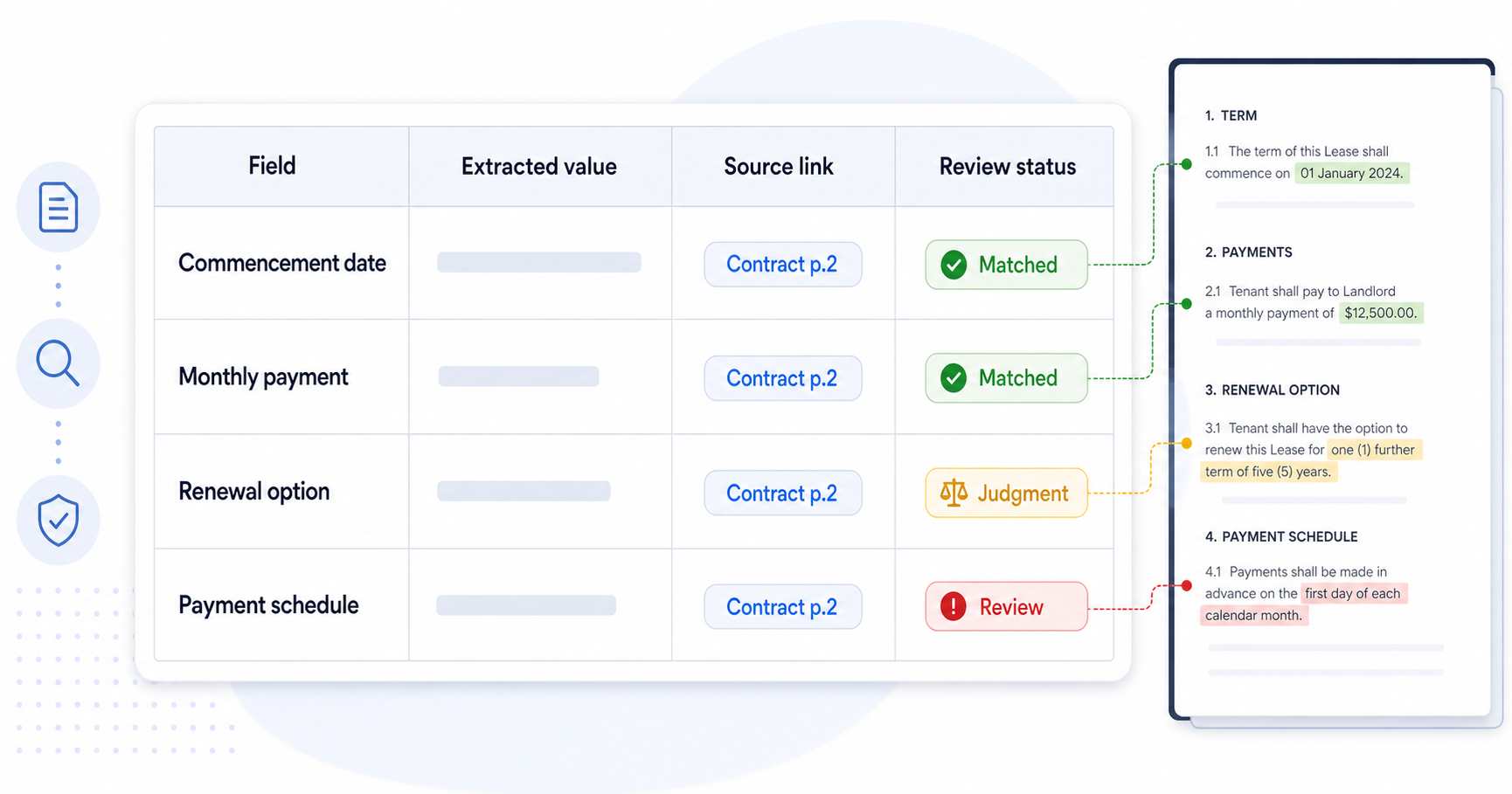
Blast Audit is built around the Excel audit workflow instead. With Snip, the auditor can draw around the lease term, payment amount, or renewal clause and place the extracted value directly into a cell with a traceable source link.
What DataSnipper Covers vs What Blast Audit Can Own
DataSnipper is a strong competitor in financial document automation. Its site describes an audit and finance platform for collecting, extracting, cross-referencing, and verifying data: DataSnipper.
That positioning explains why datasnipper.com can rank for informational accounting terms. The competitor data in this brief shows the gap clearly: datasnipper.com has roughly 50K organic visits per month, a domain authority of 60/100, and about 601 top-3 pages, while blast-audit.com has roughly 21 organic visits per month and no top-3 pages yet.
The opportunity for Blast Audit is narrower and sharper. A generic lessee definition page can answer "what does lessee mean?" Blast Audit can answer the next audit-specific question: "How do I turn this lease contract into reliable Excel evidence?"
| Topic | DataSnipper-style document automation angle | Blast Audit Excel audit angle | Why it matters to a lease audit |
|---|---|---|---|
| Definition | Explain lease parties and document concepts | Explain the party, then map it to workpaper testing | The auditor needs a procedure, not only a definition |
| Source documents | Extract data from financial documents | OCR lease PDFs inside Excel and keep workpaper context | Lease terms often live in long PDFs |
| Evidence extraction | Pull values out of documents | Snip terms into cells with source links | Reviewers need to click back to evidence |
| Payment matching | Cross-reference documents and data | Match lease schedules and payment evidence in Excel | Missing or mismatched payments create audit findings |
| Review traceability | Support document automation workflows | Preserve Excel-native evidence trails | Audit files need reviewer confidence |
| Evaluation path | Broad financial automation | Excel audit add-in with transparent pricing | The buyer is an audit team living in Excel |
For a direct product comparison, read DataSnipper and Blast Audit side by side. For the broader category, see audit software built for Excel teams.
Excel Audit Workflow for Lessee Contracts
The best lessee audit workflow does not start with copying text. It starts with keeping the lease evidence, calculation, and review trail together.
Step 1: Import the Lease Contract
Bring the lease PDF or scanned contract into the audit workbook environment.
If the document is scanned, run OCR first. OCR text recognition matters because a scanned contract is only an image until the words become searchable and extractable. Blast Audit's OCR feature is designed for auditors who need searchable documents without leaving Excel.
Step 2: Extract the Terms That Drive the Accounting
Use the contract to capture the fields that affect the lease schedule.
The most important fields are the commencement date, payment amount, payment frequency, lease term, renewal options, termination rights, incentives, and asset description.
Do not just paste these into a blank spreadsheet. Each value should link back to the exact source clause.
Step 3: Build or Review the Lease Schedule
The lease schedule should reflect the terms in the contract.
For a lessee, the schedule usually supports the lease liability, right-of-use asset, interest expense, amortization, and disclosure support. If the business has many leases, it should also support completeness testing.
A lease schedule is only as reliable as the evidence behind it.
Step 4: Match Payments to Evidence
Lease payments should agree to the contract, lease schedule, and general ledger.
For simple leases, this may be a monthly rent check. For complex leases, the payment may include fixed rent, variable charges, service components, insurance, tax reimbursements, or other charges.
The IRS also emphasizes recordkeeping for rental activity, noting that records help prepare financial statements, identify receipts, track deductible expenses, prepare tax returns, and support reported items if audited: IRS rental income and recordkeeping.
Step 5: Review Exceptions
The reviewer should be able to answer:
- Which contract supports this lease?
- Which clause supports the term?
- Which clause supports the payment amount?
- Which payments were matched?
- Which rows did not match?
- Which assumptions require management judgment?
If the answer requires digging through folders, the workpaper is fragile. If the reviewer can click from Excel to the source clause, the audit file is stronger.
Common Mistakes When Auditing Lessee Agreements
Mistake 1: Treating the Definition as the End Point
Knowing that the company is the lessee is only step one. The audit work starts after that.
The team still needs to inspect the contract, extract terms, test calculations, and document support.
Mistake 2: Missing Embedded Leases
Some contracts do not have "lease" in the title. A service agreement can still contain the right to use an identified asset.
The IFRS Foundation's lease definition guidance is useful here because it focuses on control of an identified asset, not only labels in the contract.
Mistake 3: Copying Values Without Evidence Links
Manual copy-paste may produce the right number, but it creates a weak review trail.
For audit work, the extracted value should point back to the source. This is the core reason Blast Audit focuses on Excel evidence rather than generic document summaries.
Mistake 4: Ignoring Modifications
Lease changes can affect the schedule. A renewal, termination, added space, removed asset, or payment change may require reassessment.
Cornell's e-CFR text for 26 CFR § 1.467-1 shows how lease-related tax rules can become sensitive to payment timing, deferred rent, prepaid rent, modifications, and rent schedules: 26 CFR § 1.467-1.
The audit point is simple: terms and changes matter.
Related Reading
This page is part of the long-tail lease and Excel audit cluster Blast Audit can realistically compound before chasing broad head terms where datasnipper.com has a large domain authority advantage.
- If you are comparing tools directly, read DataSnipper vs Blast Audit.
- If you want a broader product view, read Best Audit Software for Excel in 2026.
- If you need the quick definition variant, read Define Lessee.
- If you are testing the owner/provider side, read Lessor Meaning.
- If you need the lease accounting concept behind lessee-side balance sheet recognition, read Understanding the Right of Use Asset.
- If you are converting lease PDFs into workpaper-ready data, read PDF to Excel for Auditors.
FAQs About Lessee Meaning
What does lessee mean?
A lessee is the party that receives the right to use an asset under a lease. The lessee usually pays the lessor and follows the lease terms.
Is a lessee the same as a tenant?
Often, yes. In a property lease, the tenant is usually the lessee. In equipment, vehicle, or other asset leases, "lessee" is the broader term.
What is the difference between a lessee and a lessor?
The lessee uses the asset and usually makes lease payments. The lessor provides or owns the asset and receives the payments.
Is the lessee the owner of the asset?
Usually no. The lessee has the right to use the asset during the lease term, while the lessor typically retains ownership. Some finance lease structures may transfer risks and rewards or include purchase options, so auditors should read the contract.
What does a lessee record under ASC 842?
Under ASC 842, lessees generally recognize lease assets and lease liabilities for leases with terms over 12 months. Auditors should consult the applicable accounting guidance and inspect the contract support.
What does a lessee record under IFRS 16?
Under IFRS 16, lessees generally recognize a right-of-use asset and lease liability using a single lessee accounting model. IAS Plus summarizes this model in its IFRS 16 overview.
What lease terms should auditors extract from a lessee contract?
Auditors usually extract the commencement date, lease term, payment schedule, renewal options, termination rights, incentives, asset description, and purchase options.
How can auditors test lessee lease evidence in Excel?
Auditors can import the lease contract, run OCR if needed, extract source-linked terms into Excel, match payments to the lease schedule, and review exceptions. Blast Audit supports this workflow with OCR, Snip, and Matching.
Final Takeaway
"Lessee" means the party that uses an asset under a lease. For auditors, that definition matters because it points to the side of the contract where lease liabilities, right-of-use assets, payment schedules, and source evidence must be tested.
DataSnipper can compete on broad financial document automation. Blast Audit can win the Excel-specific audit workflow: extract the lease terms, match the evidence, and keep the reviewer inside the workbook.
Ready to make lessee contract testing easier in Excel? Review Blast Audit's transparent pricing or start with source-linked lease evidence in Snip.